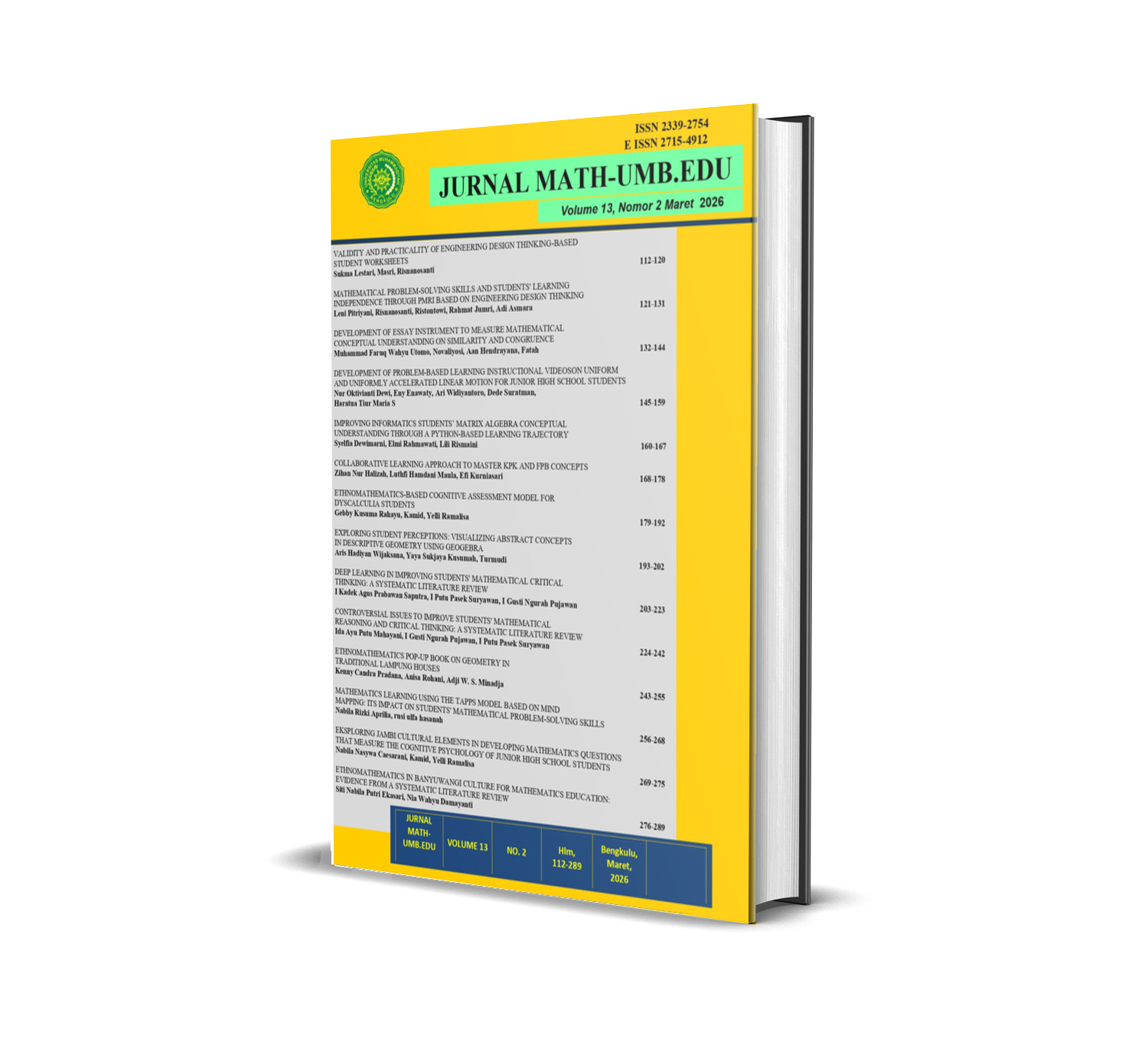
CONTROVERSIAL ISSUES TO IMPROVE STUDENTS' MATHEMATICAL REASONING AND CRITICAL THINKING: A SYSTEMATIC LITERATURE REVIEW
Bali, Indonesia
DOI:
https://doi.org/10.36085/math-umb.edu.v13i2.9883Abstract
The rapid development of education in the digital era and the Industrial Revolution 4.0 requires students to master higher-order thinking skills such as reasoning and critical thinking, which are essential for solving complex mathematical problems. This study aims to analyze and describe the role of controversial issues in developing students’ mathematical reasoning and critical thinking skills. The research employed a Systematic Literature Review (SLR) with a descriptive qualitative approach. Articles were selected through a systematic search of Google Scholar, ResearchGate, Scopus, ERIC, and Web of Science using keywords related to controversial issues, mathematical reasoning, and critical thinking. The inclusion criteria consisted of national journal and international journal articles published between 2020 and 2025, focusing on mathematics learning contexts and discussing the relationship between controversial issues and higher-order thinking skills. A total of twenty relevant articles were selected and analyzed thematically to identify patterns related to controversial mathematical problems, reasoning processes, and critical thinking development. The results indicate that the integration of controversial issues in mathematics learning can stimulate constructive cognitive conflict, argumentative discussion, and reflective thinking, which contribute to the improvement of students’ mathematical reasoning and critical thinking skills. Topics such as conceptual misconceptions, contextual mathematical problems, and socio-scientific issues encourage students to analyze information, evaluate arguments, and construct logical solutions. In addition, several studies highlight the important role of teachers in designing and facilitating controversial problem-based learning to optimize these cognitive processes. Overall, controversial issues provide an effective pedagogical approach for fostering reasoning, analytical thinking, and reflective judgment as essential competencies in 21st-century mathematics education.
Keywords: Controversial Issues, Mathematical Reasoning, Critical Thinking.
References
Arjudin, A., Sripatmi, S., Prayitno, S., Tyaningsih, R. Y., & Salsabila, N. H. (2022). Pendampingan Pengembangan Soal Matematika Berkarakteristik Kemampuan Berpikir Kritis pada Guru-Guru Matematika SMP/MTs di Kecamatan Labuapi Kabupaten Lombok Barat. Rengganis Jurnal Pengabdian Masyarakat, 2(2), 135–146. https://doi.org/10.29303/rengganis.v2i2.229
Asmoro, S. P., Suciati, S., & Prayitno, B. A. (2021). Empowering Scientific Thinking Skills of Students with Different Scientific Activity Types through Guided Inquiry. International Journal of Instruction, 14(1), 947–962. https://doi.org/10.29333/iji.2021.14156a
Astawan, I. G., Suarjana, I. M., Werang, B. R., Asaloei, S. I., Sianturi, M., & Elele, E. C. (2023). STEM-Based Scientific Learning and Its Impact on Students’ Critical and Creative Thinking Skills: An Empirical Study. Jurnal Pendidikan IPA Indonesia, 12(3), 482–492. https://doi.org/10.15294/jpii.v12i3.46882
Hjelte, A., Schindler, M., & Nilsson, P. (2020). Kinds of Mathematical Reasoning Addressed in Empirical Research in Mathematics Education: A Systematic Review. Education Sciences, 10(10), 289. https://doi.org/10.3390/educsci10100289
Khamdanah, L., Wijaya, I., & Anjani, A. S. (2023). Pengaruh Pembelajaran Berbasis HOTS terhadap PeningkatanKemampuan Berpikir Kritis Matematis. SANTIKA 3: Seminar Nasional Tadris Matematika UIN K.H Abdurrahman Wahid Pekalongan, 33, 371–383.
Koh, K., Chapman, O., Gierus, B., & Stacey, K. (2025). Assessment of Higher-Level Mathematical Thinking Skills: A Scoping Review. ZDM – Mathematics Education, 57(4), 665–678. https://doi.org/10.1007/s11858-025-01695-y
Kristiana, T., Afandi, A., & Wahyuni, E. S. (2022). Konstruksi Perangkat Pembelajaran Menggunakan Model Guided Inquiry Disertai Socioscientific Issues Terhadap Keterampilan Berpikir Kritis. Edu Sains Jurnal Pendidikan Sains & Matematika, 10(2), 145. https://doi.org/10.23971/eds.v10i2.3412
Lessing, M.-J., & Ogbonnaya, U. I. (2025). Reasoning and proof in mathematics education: a systematic literature review. Discover Education, 5(1), 31. https://doi.org/10.1007/s44217-025-01016-1
Niyazova, G. B., Utemov, V. V., Savina, T. N., Karavanova, L. Zh., Karnaukh, I. S., Zakharova, V. L., & Galimova, E. G. (2022). Classification of open mathematical problems and their role in academic achievement and motivation of students. Eurasia Journal of Mathematics, Science and Technology Education, 18(8), 1–11. https://doi.org/10.29333/ejmste/12265
Nofrianto, R. (2021). Pengembangan Lembar Kegiatan Peserta Didik (LKPD) Berbasis Sosis-Scientific Issues Pada Pelajaran IPA Untuk Menumbuhkan Kemampuan Berpikir Kritis Peserta Didik Kelas VII SMP.
Nurwidodo, N., Romdaniyah, S. W., Sudarmanto, S., Rosanti, D., Kurniawati, K., & Abidin, Z. (2021). Analisis Profil Berpikir Kritis, Kreatif, Keterampilan Kolaboratif, dan Literasi Lingkungan Siswa Kelas 8 SMP Muhammadiyah sebagai Impak Pembelajaran Modern. Bioscientist : Jurnal Ilmiah Biologi, 9(2), 605–619. https://doi.org/10.33394/bioscientist.v9i2.4642
Oktavia, Y. (2022). Pengaruh Model Pembelajaran Kadir (Koneksi, Aplikasi, Diskursus, Improvisasi, Refleksi) Berbantuan Phet Simulation Terhadap Kemampuan Berpikir Kritis Matematis Peserta Didik.
Pujawan, I. G. N. (2023). Inovasi Pembelajaran Matematika SMK Pusat Keunggulan melalui Pendekatan STEAM Berbasis Masalah Kontroversial Terintegrasi Multimodal.
Ramadhani, A., St.Nurul Mutmainna, Mirnawati, & Irmayanti. (2023). Peran Etnomatematika Dalam Pembelajaran Matematika Pada Kurikulum 2013. COMPETITIVE: Journal of Education, 2(1), 53–68. https://doi.org/10.58355/competitive.v2i1.16
Romero, A. M., Quesada, A. A., & Estepa, C. A. (2024). Promoting critical thinking through mathematics and science teacher education: the case of argumentation and graphs interpretation about climate change. European Journal of Teacher Education, 47(1), 41–59. https://doi.org/10.1080/02619768.2021.1961736
Rosyadi, A. A. P. (2021). Analisis Berpikir Kritis Mahasiswa Dalam Menyelesaikan Masalah Kontroversial Matematika. EDU-MAT: Jurnal Pendidikan Matematika, 9(1), 1–13. https://doi.org/10.20527/edumat.v9i1.9988
Suryawan, I. P. P., Jana, P., Pujawan, I. G. N., Hartawan, I. G. N. Y., & Putri, P. E. W. (2023). Ethnomathematically Controversial Problem-Based Multimodal Approach in Terms of Students’ Critical Thinking Ability. Pegem Journal of Education and Instruction, 13(3), 323–336. https://eric.ed.gov/?id=EJ1387864
Suryawan, I. P. P., Nitiasih, P. K., Riastini, P. N., & Sudiarta, I. G. P. (2023). Controversial Mathematical Issues : Problem Based Learning on Critical Thinking. Jurnal Kependidikan: Jurnal Hasil Penelitian Dan Kajian Kepustakaan Di Bidang Pendidikan, Pengajaran Dan Pembelajaran, 9(3), 808–821. https://doi.org/10.33394/jk.v9i3.8210
Suryawan, I. P. P., & Ratnaya, I. G. (2023). Analisis Berpikir Kritis Matematis Siswa Dalam Menyelesaikan Masalah Kontroversial [The Analysis Of Students’ Mathematical Critical Thinking For Solving Controversial Issues]. JOHME: Journal of Holistic Mathematics Education, 7(1), 91–107. https://doi.org/10.19166/johme.v7i1.6523
Susiswo, S., Rosyadi, A. A. P., Utami, O. R. P., Sudirman, S., Lestyanto, L. M., & Azizah, A. (2022). Eksplorasi Persepsi Calon Guru Dalam Menyelesaikan Masalah Kontroversial Matematika. AKSIOMA: Jurnal Program Studi Pendidikan Matematika, 11(4), 2977–2984. https://doi.org/10.24127/ajpm.v11i4.6163
Swastika, A., Wulan, E. R., & Hamidah, D. (2022). Potret Keterampilan Metakognitif Problem Solving dalam Level Penalaran Kontroversial Siswa. Jurnal Tadris Matematika, 5(2), 207–222. https://doi.org/10.21274/jtm.2022.5.2.207-222
Turmuzi, M., Suharta, I. G. P., & Suparta, I. N. (2023). Ethnomathematical research in mathematics education journals in Indonesia: A case study of data design and analysis. Eurasia Journal of Mathematics, Science and Technology Education, 19(1), 1–13. https://doi.org/10.29333/ejmste/12836
Utomo, A. P., Narulita, E., & Billah, R. N. I. (2020). Penerapan model pembelajaran problem based learning berbasis socio-scientific issue (SSI) terhadap kemampuan berpikir kritis siswa SMP. JIPVA (Jurnal Pendidikan IPA Veteran), 4(2), 148–159. https://e-journal.ivet.ac.id/index.php/jipva/article/view/1259
Viehmann, C., Fernández Cárdenas, J. M., & Reynaga Peña, C. G. (2024). The Use of Socioscientific Issues in Science Lessons: A Scoping Review. Sustainability, 16(14), 5827. https://doi.org/10.3390/su16145827
Walida, S. El, Sari, F. K., Ismi, Y., & Khairunnisa, G. F. (2024). Aktivitaspenalaran Kontroversial Mahasiswa Dalam Menyelesaikan Masalah Aljabar. Histogram: Jurnal Pendidikan Matematika, 8(1), 1–13. https://doi.org/https://doi.org/10.31100/histogram.v8i1.3283
Wang, M., Mohd Matore, M. E. E., & Rosli, R. (2025). A systematic literature review on analytical thinking development in mathematics education: trends across time and countries. Frontiers in Psychology, 16. https://doi.org/10.3389/fpsyg.2025.1523836
Wang, Q., & Abdullah, A. H. (2024). Enhancing Students’ Critical Thinking Through Mathematics in Higher Education: A Systemic Review. Sage Open, 14(3). https://doi.org/10.1177/21582440241275651
Yanti, K. G. D., Pujawan, I. G. N., & Mahayukti, G. A. (2019). Meningkatkan Kemampuan Penalaran Matematis Siswa Melalui Penerapan Pendekatan Metaphorical Thinking. Jurnal IKA, 16(2), 83–97. https://doi.org/10.23887/ika.v16i2.19828
Yuspitasari. (2023). Pengembangan E-LKPD Berbasis SocioScientific Issues pada Materi Sistem Pernapasan untuk Meningkatkan Berpikir Kritis Peserta Didik.