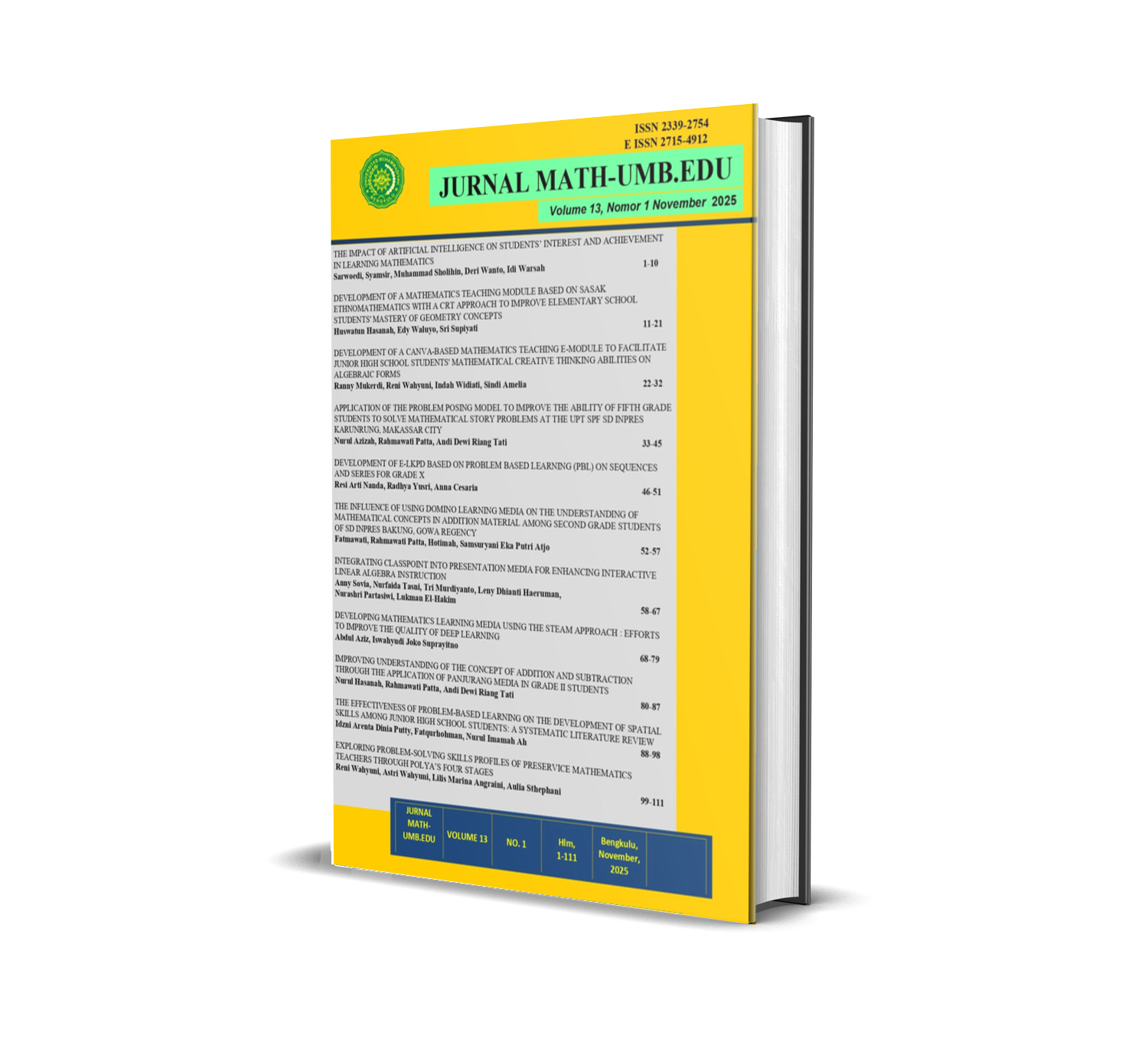
THE IMPACT OF ARTIFICIAL INTELLIGENCE ON STUDENTS’ INTEREST AND ACHIEVEMENT IN LEARNING MATHEMATICS
Bengkulu, Indonesia
DOI:
https://doi.org/10.36085/mathumbedu.v13i1.9050Abstract
This study investigates the impact of Artificial Intelligence (AI) on students’ interest and achievement in learning mathematics compared to the use of printed textbooks. A quasi-experimental design was employed with two groups of senior high school students: the experimental group utilized AI-based applications, while the control group relied on printed textbooks as the main learning resource. Research instruments included a learning interest questionnaire, achievement tests, and classroom observations. The results indicate that students learning with AI demonstrated higher levels of interest due to interactivity and personalized content. Furthermore, there was a significant difference in learning outcomes between the AI group and the textbook group. The findings suggest that integrating AI into mathematics instruction can serve as an innovative strategy to foster student motivation and improve academic performance, while printed textbooks remain valuable as supplementary learning resources.
Keywords: Artificial Intelligence, learning interest, learning outcomes, mathematics
References
Aleven, V., McLaughlin, E. A., Glenn, R. A., & Koedinger, K. R. (2016). Instruction based on intelligent tutoring systems. In R. E. Mayer & P. A. Alexander (Eds.), Handbook of research on learning and instruction (2nd ed., pp. 419–436). Routledge. https://doi.org/10.4324/9781315736419
Al-Mahrooqi, R., & Denman, C. (2023). Artificial intelligence in education: Potentials and challenges in the Gulf context. Education and Information Technologies, 28(4), 4119–4136. https://doi.org/10.1007/s10639-023-11627-4
Alneyadi, S., Wardat, Y., Al Shammari, A., & Al-Juboori, Z. (2024). Exploring the impact of artificial intelligence in teaching and learning of science: A systematic review. Research in Science Education. https://doi.org/10.1007/s11165-024-10176-3
Bishop, J. L., & Verleger, M. A. (2013). The flipped classroom: A survey of the research. ASEE National Conference Proceedings, 30(9), 1–18. https://doi.org/10.18260/1-2--22585
Chen, F., & Xie, H. (2020). Effects of AI-assisted mathematics learning on students’ problem-solving ability. International Journal of Artificial Intelligence in Education, 30(4), 617–635. https://doi.org/10.1007/s40593-020-00211-9
Chi, M. T. H. (2009). Active-constructive-interactive: A conceptual framework for differentiating learning activities. Topics in Cognitive Science, 1(1), 73–105. https://doi.org/10.1111/j.1756-8765.2008.01005.x
Clark, R. C., & Mayer, R. E. (2016). e-Learning and the science of instruction: Proven guidelines for consumers and designers of multimedia learning (4th ed.). Wiley. https://doi.org/10.1002/9781119239086
Dede, C. (2014). The role of digital technologies in deeper learning. Students at the Center: Deeper Learning Research Series. Jobs for the Future. https://studentsatthecenterhub.org/resource/the-role-of-digital-technologies-in-deeper-learning
Dwi, M., & Susanto, A. (2021). Efektivitas penggunaan buku cetak terhadap pemahaman bacaan matematika siswa SMA. Jurnal Pendidikan Matematika Indonesia, 6(2), 123–134. https://doi.org/10.26737/jpmi.v6i2.2134
Hattie, J. (2009). Visible learning: A synthesis of over 800 meta-analyses relating to achievement. Routledge. https://doi.org/10.4324/9780203887332
Hattie, J., & Timperley, H. (2007). The power of feedback. Review of Educational Research, 77(1), 81–112. https://doi.org/10.3102/003465430298487
Herawaty, D., Sarwoedi, S., Marinka, D. O., Febriani, P., & Wirne, I. N. (2019). Improving student’s understanding of mathematics through ethnomathematics. Journal of Physics: Conference Series, 1318(1), 012080. https://doi.org/10.1088/1742-6596/1318/1/012080
Hidi, S., & Renninger, K. A. (2006). The four-phase model of interest development. Educational Psychologist, 41(2), 111–127. https://doi.org/10.1207/s15326985ep4102_4
Holmes, W., Bialik, M., & Fadel, C. (2019). Artificial intelligence in education: Promises and implications for teaching and learning. Center for Curriculum Redesign. https://curriculumredesign.org/our-work/artificial-intelligence-in-education
Hollands, F. M., & Tirthali, D. (2014). MOOCs: Expectations and reality. Full report. Teachers College, Columbia University. https://eric.ed.gov/?id=ED547237
Huda, M., Jasmi, K. A., Hehsan, A., Shahrill, M., Mustari, M. I., Basiron, B., & Maseleno, A. (2018). Empowering children with adaptive technology skills. International Electronic Journal of Elementary Education, 10(2), 249–261. https://iejee.com/index.php/IEJEE/article/view/363
Jumri, R., & Murdiana. (2022). Kemampuan Representasi Matematis Siswa dengan Resource Based Learning. Aksioma, 11(1), 1–7. https://scholar.google.com/citations?view_op=view_citation&hl=id&user=iGyPQTAAAAAJ&pagesize=80&citation_for_view=iGyPQTAAAAAJ:Y0pCki6q_DkC
Jumri, R., Widada, W., & Herawaty, D. (2018). Improving the Innovation of Mathematics Education Undergraduate through Cooperative Learning. International Journal of Science and Research, 7(2), 656–662. https://doi.org/10.21275/ART201818
Kasneci, E., Sessler, K., Kitchenham, B., & Kasneci, G. (2023). ChatGPT for good? On opportunities and challenges of large language models for education. Computers and Education: Artificial Intelligence, 4, 100179. https://doi.org/10.1016/j.caeai.2023.100179
Koedinger, K. R., Corbett, A. T., & Perfetti, C. (2012). The knowledge-learning-instruction framework. Cognitive Science, 36(5), 757–798. https://doi.org/10.1111/j.1551-6709.2012.01245.x
Kulik, J. A., & Fletcher, J. D. (2016). Effectiveness of intelligent tutoring systems: A meta-analytic review. Journal of Educational Psychology, 108(6), 1–18. https://doi.org/10.1037/edu0000070
Lee, J., Park, H., & Kim, S. (2022). The effect of AI-based learning on STEM achievement among Korean high school students. Journal of Science Education and Technology, 31(6), 821–835. https://doi.org/10.1007/s10956-022-09983-6
Luckin, R., Holmes, W., Griffiths, M., & Forcier, L. B. (2016). Intelligence unleashed: An argument for AI in education. Pearson. https://www.pearson.com/en-us/insights-and-research/learning/insights/intelligence-unleashed.html
Ma, W., Adesope, O. O., Nesbit, J. C., & Liu, Q. (2014). Intelligent tutoring systems and learning outcomes: A meta-analysis. Review of Educational Research, 84(4), 740–772. https://doi.org/10.3102/0034654314540007
Mangen, A., Walgermo, B. R., & Brønnick, K. (2013). Reading linear texts on paper versus computer screen: Effects on reading comprehension. International Journal of Educational Research, 58, 61–68. https://doi.org/10.1016/j.ijer.2012.12.002
Mayer, R. E. (2009). Multimedia learning (2nd ed.). Cambridge University Press. https://doi.org/10.1017/CBO9780511811678
Moreno, R., & Mayer, R. E. (2007). Interactive multimodal learning environments. Educational Psychology Review, 19(3), 309–326. https://doi.org/10.1007/s10648-007-9047-2
Murphy, R., Gallagher, L., Krumm, A., Mislevy, J., & Hafter, A. (2014). Research on the use of Khan Academy in schools: Phase 1. SRI International. https://www.sri.com/publication/education-learning-pubs/research-on-the-use-of-khan-academy-in-schools-phase-1
Nugroho, A., Sari, R., & Lestari, W. (2022). Implementasi pembelajaran berbasis AI untuk meningkatkan keterampilan berpikir kritis siswa SMP. Jurnal Inovasi Pendidikan Matematika, 9(1), 15–26. https://doi.org/10.36706/jipm.v9i1.2150
OECD. (2019). PISA 2018 results: What students know and can do (Vol. I). OECD Publishing. https://doi.org/10.1787/5f07c754-en
Pane, J. F., Baird, M. D., & Hamilton, L. S. (2017). Effects of personalized learning in U.S. schools. Educational Evaluation and Policy Analysis, 39(4), 1–27. https://doi.org/10.3102/0162373717693105
Pane, J. F., Steiner, E. D., Baird, M. D., & Hamilton, L. S. (2015). Continued progress: Promising evidence on personalized learning. RAND Corporation. https://doi.org/10.7249/RR1365
Park, Y., & Kim, J. (2022). AI in STEM education: Enhancing engagement and achievement. Computers & Education, 187, 104517. https://doi.org/10.1016/j.compedu.2022.104517
Pertiwi, A., Kulsum, U., & Hanifah, I. (2025). Evaluating the impact of AI-based learning methods on students’ motivation and academic achievement. Postaxial: Journal of Education Research, 4(1), 45–56. https://journal.amorfati.id/index.php/postaxial/article/view/279
Qushwa, M. (2024). Integration of artificial intelligence in online learning: Impact on student outcomes. Indonesian Journal on Information Technology, 9(2), 133–145. https://ejournal.unuja.ac.id/index.php/IJIT/article/view/9328
Rachmawati, I. (2022). Pengaruh aplikasi pembelajaran berbasis AI terhadap hasil belajar matematika siswa SMA. Jurnal Pendidikan Matematika, 16(2), 98–109. https://doi.org/10.21831/jpm.v16i2.4145
Roll, I., & Wylie, R. (2016). Evolution and prospects of AI in education. International Journal of Artificial Intelligence in Education, 26(2), 582–599. https://doi.org/10.1007/s40593-016-0099-6
Roscoe, R. D., & Chi, M. T. H. (2008). Tutor learning: The role of explaining and responding to questions. Instructional Science, 36(4), 321–350. https://doi.org/10.1007/s11251-007-9034-5
Roschelle, J., Feng, M., Murphy, R. F., & Mason, C. A. (2016). Online mathematics homework increases student achievement. AERA Open, 2(4), 1–12. https://doi.org/10.1177/2332858416673968
Sarwoedi, S., Marinka, D. O., Febriani, P., & Wirne, I. N. (2018). Efektifitas etnomatematika dalam meningkatkan kemampuan pemahaman matematika siswa. Jurnal Pendidikan Matematika Raflesia, 3(2), 171–182. https://ejournal.unib.ac.id/index.php/jpmr
Singer, L. M., & Alexander, P. A. (2017). Reading across mediums: Digital vs. print. Journal of Experimental Education, 85(1), 155–172. https://doi.org/10.1080/00220973.2016.1143794
Skinner, B. F. (1953). Science and human behavior. Macmillan. https://doi.org/10.1037/10756-000
Sweller, J. (1988). Cognitive load during problem solving: Effects on learning. Cognitive Science, 12(2), 257–285. https://doi.org/10.1207/s15516709cog1202_4
Suyadi, & Yulianti, E. (2017). Integrasi pendidikan karakter dalam pembelajaran berbasis digital di sekolah. Jurnal Pendidikan Karakter, 7(2), 123–134. https://doi.org/10.21831/jpk.v7i2.16470
Tlili, A., Shehata, B., Adarkwah, M. A., Bozkurt, A., Hickey, D. T., & Aarts, A. A. (2023). Policies for using artificial intelligence in education. Computers and Education: Artificial Intelligence, 4, 100203. https://doi.org/10.1016/j.caeai.2023.100203
VanLehn, K. (2011). The relative effectiveness of human tutoring, intelligent tutoring systems, and other tutoring systems. Educational Psychologist, 46(4), 197–221. https://doi.org/10.1080/00461520.2011.611369
Vygotsky, L. S. (1978). Mind in society: The development of higher psychological processes. Harvard University Press.
Wang, Y., Vogel, D., & Ran, W. (2011). The effects of computer-assisted instruction on student learning: A meta-analysis. International Journal of Computer-Supported Collaborative Learning, 6(3), 1–22. https://doi.org/10.1007/s11412-011-9101-9
Winanda, D. R., Jumri, R., & Ramadianti, W. (2024). Penggunaan Media Pecahan untuk Pembelajaran Matematika Menyenangkan Kelas V SDN 65 Kota Bengkulu. Journal of Human and Education, 4(3), 553–558. https://scholar.google.com/citations?view_op=view_citation&hl=id&user=iGyPQTAAAAAJ&pagesize=80&citation_for_view=iGyPQTAAAAAJ:9ZlFYXVOiuMC
Woolf, B. P. (2010). Building intelligent interactive tutors: Student-centered strategies for revolutionizing e-learning. Morgan Kaufmann. https://doi.org/10.1016/C2009-0-61125-2
Yang, X., Sun, T., & Liu, J. (2021). The role of AI in mathematics education: Feedback and student confidence. International Journal of Educational Technology in Higher Education, 18(1), 1–15. https://doi.org/10.1186/s41239-021-00262-5
Zain, M., & Abdullah, N. (2024). Digital transformation in education: AI and student engagement. International Journal of Education and Instruction, 13(2), 55–70. https://doi.org/10.46328/ijei.v13i2.2379
Zawacki-Richter, O., Marín, V. I., Bond, M., & Gouverneur, F. (2019). Systematic review of research on AI applications in higher education. International Journal of Educational Technology in Higher Education, 16(1), 39. https://doi.org/10.1186/s41239-019-0171-0
Zheng, L., Chu, S. K. W., & Keum, J. (2022). Adaptive learning systems in mathematics education: A systematic review. Education and Information Technologies, 27(8), 11175–11204. https://doi.org/10.1007/s10639-022-11140-5
Zheng, Y., & Warschauer, M. (2018). Participation, interaction, and academic achievement in technology-enhanced learning. Computers & Education, 123, 1–17. https://doi.org/10.1016/j.compedu.2018.04.012
Zwart, D. P., Noroozi, O., van Luit, J. E., Goei, S. L., & Nieuwenhuis, A. (2017). Digital tools in mathematics education: A meta-analysis. Journal of Computer Assisted Learning, 33(5), 421–433. https://doi.org/10.1111/jcal.12197